
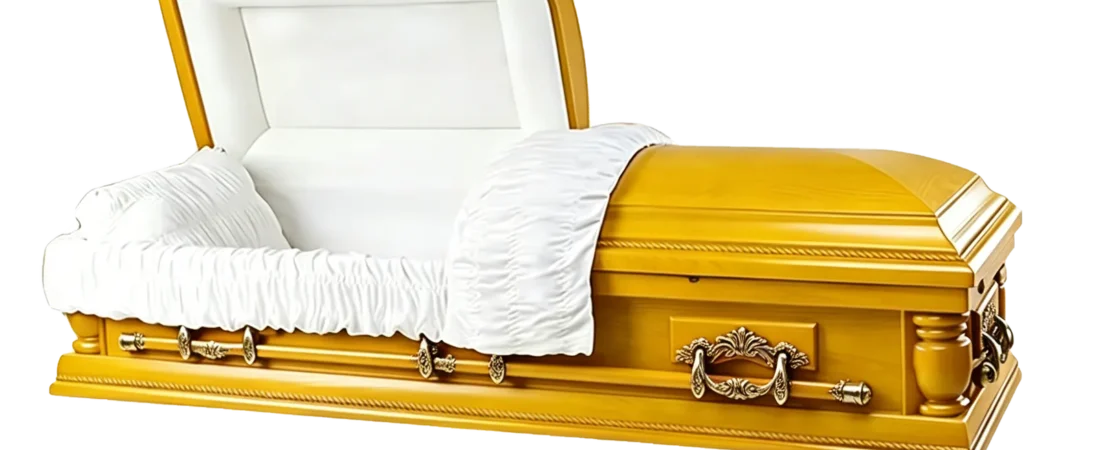
American-style caskets and European-style coffins serve the same fundamental purpose, but their shape, presentation, interior treatment, hardware and market expectations can differ significantly.
For importers, funeral homes and distributors, the important issue is not which style is “better.” It is which product specification fits the customers and funeral practices in the intended market.
Peynaro has more than 30 years of manufacturing experience across traditional coffins, European styles and American-style caskets. That experience has reinforced a simple sourcing rule: never assume a product that sells well in one market will automatically fit another.
Casket vs. coffin: the basic shape difference
In common U.S. usage, a casket is usually rectangular with four sides and often uses a hinged lid and upholstered interior. A coffin traditionally has a body-shaped or tapered profile, wider around the shoulders and narrower toward the head and feet.
Funeral education sources such as Funeralwise also distinguish the two primarily by design and shape.
| Feature | American-style casket | European-style coffin |
|---|---|---|
| Typical body shape | Rectangular, parallel sides | Often tapered or shaped, depending on country and tradition |
| Presentation | Often more upholstered and hardware-focused | Can range from simple natural wood to highly finished traditional designs |
| Interior | Frequently padded and decorative | Varies widely by market |
| Hardware | Decorative handles and fittings are common | May use simpler handles or market-specific fittings |
| Buyer focus | Presentation, finish, hardware, interior | Shape, wood/finish, tradition, local specification |
American-style caskets
American-style caskets commonly emphasize presentation. Depending on the model, buyers may see:
- Rectangular construction
- Hinged or split lid arrangements
- Upholstered interiors
- Decorative handles
- Metal or wood fittings
- Painted, polished or wood-grain finishes
To compare available models, browse our American-style casket collection and review the American-style oak wood casket example. If you are sourcing for a European market, explore our European-style coffin range and confirm dimensions and construction for your destination country.
European-style coffins are not one single standard
“European-style coffin” is a broad category rather than one exact specification. Shape, lid design, dimensions, wood species, handles and decoration can vary from one European market to another.
That means a buyer should specify the actual destination country or provide a local reference model instead of assuming that one “European coffin” fits the whole region.
Interior design can change the product positioning
Interior treatment affects both appearance and price. Buyers should confirm:
- Fabric type
- Color
- Pillow and mattress/base treatment
- Side lining
- Lid interior
- Decorative trim
Do not judge the interior specification from exterior photos alone.
Handles and hardware deserve a separate specification
Handles can be a major part of the visual identity of an American-style casket, while some European products use more restrained fittings.
Possible options include:
- Individual handles
- Continuous bar handles
- Wood handles
- Metal handles
- Decorative polymer fittings
- Market-specific hardware sets
The handle material, finish and mounting method should be written into the RFQ because hardware can materially affect cost.
Materials and finishes
Both caskets and coffins can be produced from different materials, including solid wood, engineered wood, MDF, metal, cardboard and woven natural materials.
Surface options can include natural wood appearance, stain, paint, polished finishes, printed decoration or other treatments. Buyers should confirm the material beneath the finish rather than purchasing on appearance alone.
Dimensions and packaging vary by market
External dimensions, internal dimensions, handle projection and package size affect both user fit and logistics.
| Dimension to confirm | Why it matters |
|---|---|
| Overall length and width | Market fit, storage and transportation |
| Internal usable dimensions | Product suitability |
| Overall height | Presentation and warehouse space |
| Handle projection | Clearance and packed size |
| Package dimensions | Container loading and landed cost |
How should a distributor choose between the two?
Start with the market, not the factory catalog. Consider:
- Local funeral traditions
- Funeral-home preferences
- Existing competitor products
- Target retail price
- Storage and transportation
- Required materials and finishes
- Customization needs
A distributor can also use OEM/ODM development to combine selected features—for example, a market-specific body shape with a different interior, handle style or private-label package.
FAQ: American-style caskets and European-style coffins
Is a casket the same as a coffin?
They are both burial containers, but in common English-language usage “casket” usually refers to a rectangular form, while “coffin” often refers to a tapered or body-shaped form.
Are American-style caskets always metal?
No. American-style caskets can be produced in wood, metal and other materials depending on the design.
Is there one standard European coffin size?
No. Requirements vary by country, market and customer, so buyers should confirm dimensions and local expectations before ordering.
Can a supplier customize a European or American design?
Yes, depending on the construction and quantity. Common changes include dimensions, material, finish, interior, handles, branding and packaging.
Choose by market fit, not by label
The names “American-style” and “European-style” are useful starting points, but a professional RFQ should go deeper into dimensions, materials, finish, interior, hardware and packaging.
For broader supplier evaluation, read Peynaro’s custom casket manufacturer sourcing guide. You can also send us a local reference model or drawing for a manufacturing review.